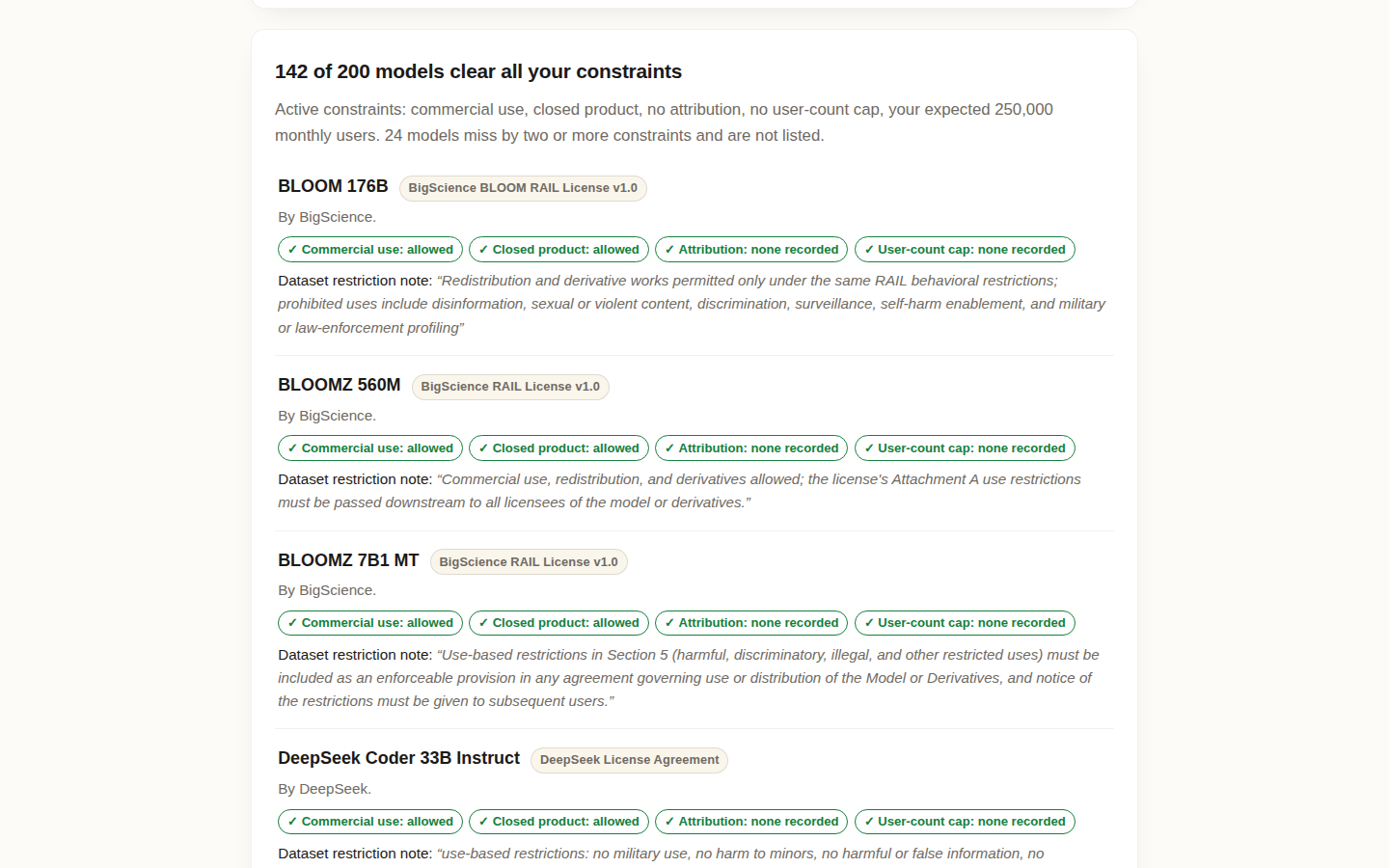
A license that allows commercial use can still sink a launch four other ways. We ran ShipSafe Filter with a realistic shipping profile switched on: commercial use, closed proprietary product, no attribution required, no user-count cap, and 250,000 expected monthly users. Of the 200 models in the dataset, 142 clear every constraint, 34 miss by exactly one, and 24 miss by two or more. Six checks explain almost all of the failures.
1. Commercial use is the first check, not the only one
Eight of the 200 models are recorded as not allowing commercial use at all. That part is easy to grep. The harder failures hide downstream, which is why our guide to reading a model license in 5 minutes treats the license name as a starting point, not a verdict.
2. Closed product is where permissive quietly ends
A model can allow redistribution and still carry a share-alike duty that opens your product up. The closed product constraint fails on exactly that. Use-restriction duties that pass downstream, the RAIL, DeepSeek and Gemma pattern, are not counted as copyleft by the filter, because they bind how the model is used, not whether your product stays closed. Know which kind of duty you are looking at.
3. Attribution duties hide in the restriction notes
45 models in the dataset carry an attribution duty: a notice file, model branding such as "Built with Llama", displaying the model name in your product, or keeping copyright and license notices in place. None of that is hard. All of it is embarrassing to discover after launch. Our Gemma license walkthrough shows how much of the real terms live outside the headline license.
4. A user-count cap is a date on the calendar
The filter counts a cap only when the recorded terms tie a monthly-active-user threshold to a separate license or permission: the Llama pattern at 700M users and the older Qwen pattern at 100M. A threshold that only triggers a branding display, as in the Kimi K2 terms, is not a cap, and the filter says so. Our 700M MAU threshold explainer and the Qwen license terms page cover the two patterns in detail.
5. The expected-users field turns a cap into a planning number
Set 250,000 monthly users and every model whose recorded cap sits below that number drops out, with the cap printed on its card. Sitting exactly at the cap still clears, because the recorded terms trigger above the threshold. It is the difference between a license that fits your launch and one that fits your launch year.
6. Read the restriction note, not just the license name
The BLOOM family tops the cleared list in our run, and every BLOOM card still carries its RAIL note: use restrictions that must pass downstream to anyone you ship to. DeepSeek Coder 33B clears too, with its own use restrictions recorded. Cleared never means unrestricted; it means your constraints, as recorded, are met. When the budget question follows the license question, the FreeTier Finder at AIToolGuide checks which tools still record a free tier, and the model catalogues at Hugging Face are where most teams go reading after the filter. The discipline is the cheap part: run your real constraints through ShipSafe before the architecture hardens around a model you cannot ship.