Ask what license an open model carries and the honest answer is: one of about fifty. Our dataset of 200 open models, the records behind the ShipSafe Filter, holds 50 distinct license names. They sort into a handful of types, and the types matter more than the names: each type answers the commercial question differently, attaches different duties, and hides its conditions in different places. This guide walks the types as they actually appear on real models, with the counts, then turns to choosing between them and staying compliant.
The types, at their real frequencies
| License type | Models in the dataset | Commercial use | Signature duty or condition |
|---|---|---|---|
| Apache License 2.0 | 87 | Allowed | Attribution and notices; explicit patent grant |
| MIT License (plus Modified MIT) | 29 (plus 2) | Allowed | Keep the copyright notice; nothing else of weight |
| Llama Community Licenses | 23 | Allowed, with a ceiling | Separate license needed above 700M monthly users; "Built with Llama" display duty |
| Gemma Terms of Use | 14 | Allowed, with conditions | Prohibited Use Policy; terms pass through on redistribution |
| DeepSeek license agreements | 10 | Allowed | Use restrictions in an attachment; notices retained |
| Qwen and Tongyi Qianwen agreements | 6 | Mostly allowed | Separate permission above 100M monthly users on the large models |
| NVIDIA open model licenses | 7 | Allowed | Vendor terms layered on the model release |
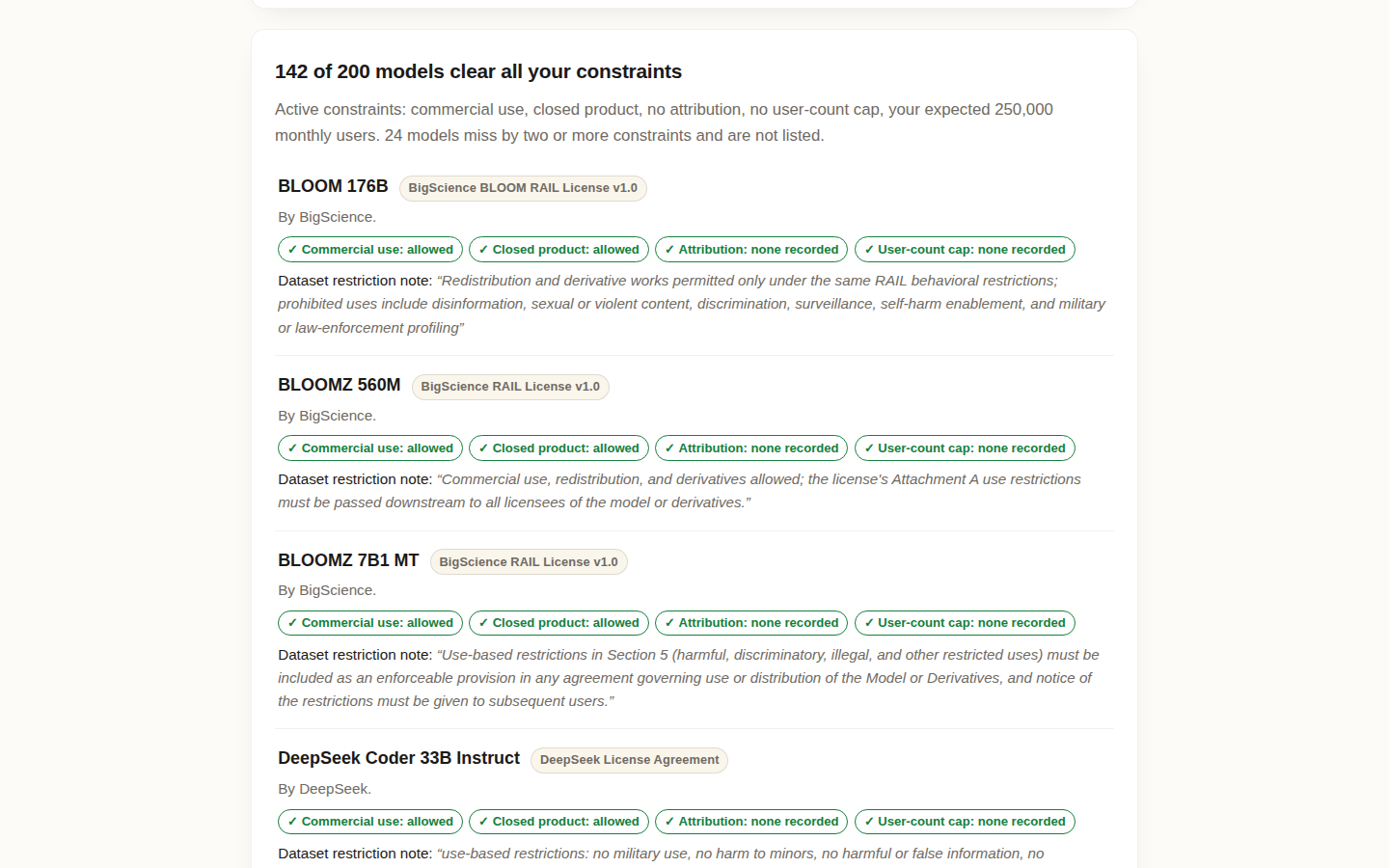
| RAIL licenses | 6 | Allowed, with use limits | Behavioral use restrictions written into the license itself |
| Creative Commons (BY-NC and BY-SA) | 2 | BY-NC: not allowed | Noncommercial means noncommercial, whatever the model page implies |
| Everything else (Falcon, Apple, research licenses, one-offs) | 14 | Read it individually | Includes several of the research and non-production licenses behind the dataset's 8 no-commercial models |
The two classic permissive types
Apache 2.0 is the model world's default: 87 of 200 models, more than the next three types combined. It allows commercial use, redistribution and modification, and its distinguishing asset is the explicit patent grant, the clause enterprises ask about first. MIT covers 29 models, plus 2 under a Modified MIT (one of them Kimi K2, whose modification attaches a naming and display duty at scale). MIT is shorter and simpler, with no patent clause at all. Our pairwise comparison works through what that difference is worth; the counted point here is that between them, the two classic permissive licenses cover 118 of the 200 models, and neither carries a user ceiling.
The custom community types, where the conditions live
The remaining types are vendor-written, and this is where license reading stops being a formality. The Llama community licenses (23 models) allow commercial use and then cap it: above 700 million monthly active users, a separate license from Meta is required, and products must display "Built with Llama". The Gemma Terms (14 models) permit commercial use under a Prohibited Use Policy incorporated by reference, and the terms travel with the model: redistribute it and you pass the terms, and your modification notices, downstream. The Qwen agreements put their ceiling lower, at 100 million monthly users on the large models. The RAIL licenses (6 models) take a different approach entirely, writing behavioral restrictions, the uses the licensor forbids, into the license grant itself.
Choosing a type, by what you are building
For a commercial product: 192 of the 200 models allow commercial use, so the type question is rarely can you, it is under what ceiling and with what duties. Apache and MIT carry no ceiling in our records. Community licenses carry the ceilings counted in our user caps census. The 8 models that refuse commercial use outright are named in our commercial shortlist post, and they cluster exactly where you would predict: research licenses and one Creative Commons noncommercial release. For research and personal use: nearly everything in the dataset is open to you, including those 8, which is what they were released for. The type still matters if the work might later ship; a research license in a prototype has a way of still being there at launch.
Compliance, in the dataset's numbers
Three duties recur. Attribution: required on 198 of the 200 models; only InternLM2.5 7B Chat and Nemotron 3 Nano 4B waive it, so treat attribution as a default, not a check. Restriction notes: 89 of the 200 models carry a recorded restriction beyond the headline permissions, which is why a license name alone never settles a model. Redistribution terms: every model in the dataset allows redistribution and modification on paper, but community licenses attach pass-through duties to that redistribution. The working habit that covers all three is the one in our six license checks: run them between the demo and the ship date, while changing a model is still cheap.